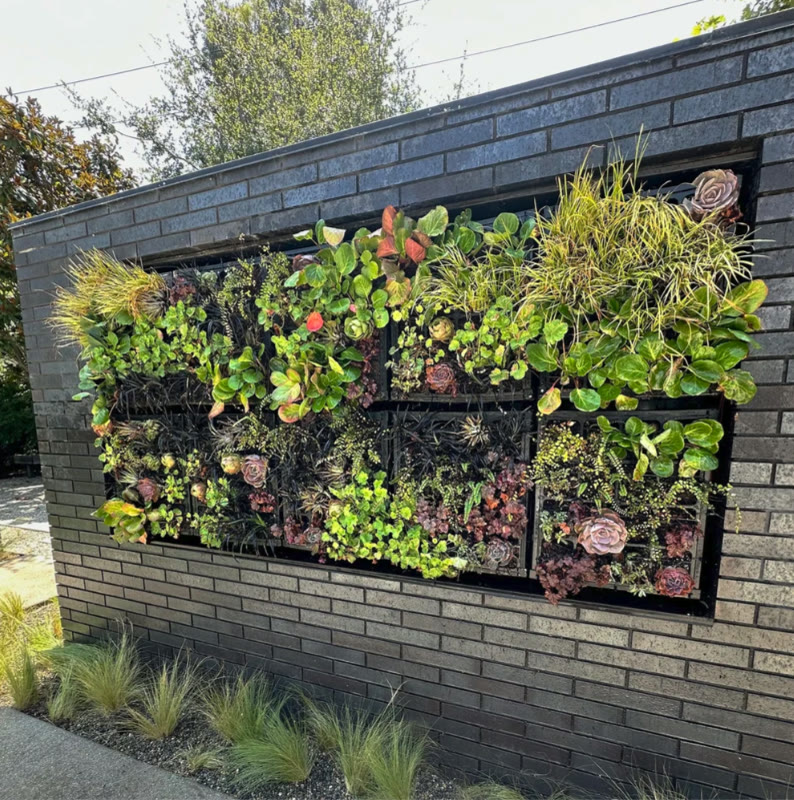
Every Los Angeles garden eventually runs into the same wall: the property line. Lots are tight, floors are spoken for, and the courtyard that wants an orchard has room for a café table. The answer this city keeps rediscovering — from Culver City office lobbies to Brentwood backyards — is that when a garden can't spread out, it can stand up.
A living wall is the most misunderstood object in our field. Photographed constantly, it gets treated as a backdrop — vertical wallpaper that happens to breathe. But the case for a living wall was never primarily visual. The beauty is the entry fee. The reasons to build one are what it does to sound, to air, and to the people in the room with it.
What it does to sound
Hard surfaces are the tax Los Angeles architecture pays for its looks. Glass, polished concrete, brick — every material we love reflects sound, and the result is rooms and courtyards that read beautifully but sound brittle. Foliage is the opposite of all of it. Thousands of irregular, soft-tissued leaf surfaces scatter and absorb sound instead of bouncing it, and a planted wall behaves acoustically like a thick textile hung across your loudest surface. The change is not subtle. Conversations near a living wall settle into a lower register; the clatter of a patio dinner stops ricocheting. Restaurants pay handsomely for acoustic panels that do less, and look like exactly what they are.
The beauty is the entry fee. The reasons to build a living wall are sound, air, and what it does to the people in the room.
What it does to air
A wall of transpiring plants is a quiet climate machine. Each leaf releases moisture as it breathes, and collectively a wall raises the humidity of its immediate surroundings — a genuine gift in a city where indoor humidity regularly sits at desert levels. Outdoors, the effect turns thermal: a planted west-facing wall absorbs and evaporates the afternoon assault that would otherwise radiate into a courtyard all evening. The surface behind dense foliage can measure dramatically cooler than bare masonry beside it. That is not decoration; that is infrastructure.
What it does to people
The research on biophilia keeps arriving at the same conclusion: humans recover attention and shed stress measurably faster in the presence of living green texture. What the studies formalize, hospitality operators learn from their reservation books — the seats near the green wall book first. A vertical garden puts more living material in a person's field of view than any arrangement of floor plants can, at exactly eye level, where it registers constantly and effortlessly. It is the difference between a room that contains plants and a room that feels alive.
The honest part: a wall is a commitment
Here is what the photographs never disclose: a living wall is a garden with the difficulty turned up. Gravity drains the top faster than the bottom. Roots live in inches of medium instead of feet of ground. Everything depends on irrigation working every single week. We build exclusively on panelized systems with concealed drip lines and timers, and we tell every client the same thing — the install is the wedding; the care program is the marriage. Expect quarterly recomposition, where underperformers are swapped and drifts are rebalanced. A wall that is planted and abandoned fails in public, one square at a time.
This is also why plant selection is stricter in the vertical plane. In Southern California we compose two reliable palettes. In full sun, a succulent tapestry — echeveria, sedum, senecio, aeonium — that treats the wall like a slow-motion painting and sips water. In bright shade, a lusher weave of ferns, heuchera, sedges, and trailing philodendron that reads tropical without demanding a rainforest's upkeep. Our Green Wall Sanctuary project in Brentwood is the first palette set into a charcoal brick frame — a composition that holds year-round and repaints itself slightly every month.
What it costs — and what it returns
Clients deserve straight numbers, so here is the shape of them. A professionally built living wall is priced closer to fine cabinetry than to landscaping: the panel system, the concealed irrigation, the mature plant material, and the structural and waterproofing details behind it all cost real money before a single leaf shows. Then comes the care program, which is not optional — budget for it the way you budget for pool service, because that is the honest comparison.
What comes back is harder to invoice but easy to observe. In hospitality, the wall becomes the most photographed square footage in the building — free media that renews itself with every seated guest. In residences, it converts a dead vertical surface into the room's identity, the thing every visitor mentions and every listing leads with. And unlike almost any other finish, it appreciates: a two-year-old wall, properly kept, is fuller, denser, and more valuable than the day it was planted. Marble is at its best the morning it's installed. A living wall is at its best next year.
The math only fails when the commitment does. Which brings us to the most important section of this piece.
When not to build one
We talk clients out of walls regularly. A wall with no irrigation line and no appetite for a care program should be a trellised vine — bougainvillea and creeping fig are magnificent, patient, and nearly free by comparison. A dark interior corridor should be a mirror and a great aspidistra, not a struggling fern panel under a grow light. The living wall earns its keep where its three superpowers — acoustics, climate, presence — are actually wanted, and where someone has committed to keeping it alive.
Get those conditions right, and nothing else in the vocabulary of design does what it does: a surface of the building itself, alive and changing, growing more valuable every year the architecture around it stays exactly the same.
— Maia Flora, Los Angeles