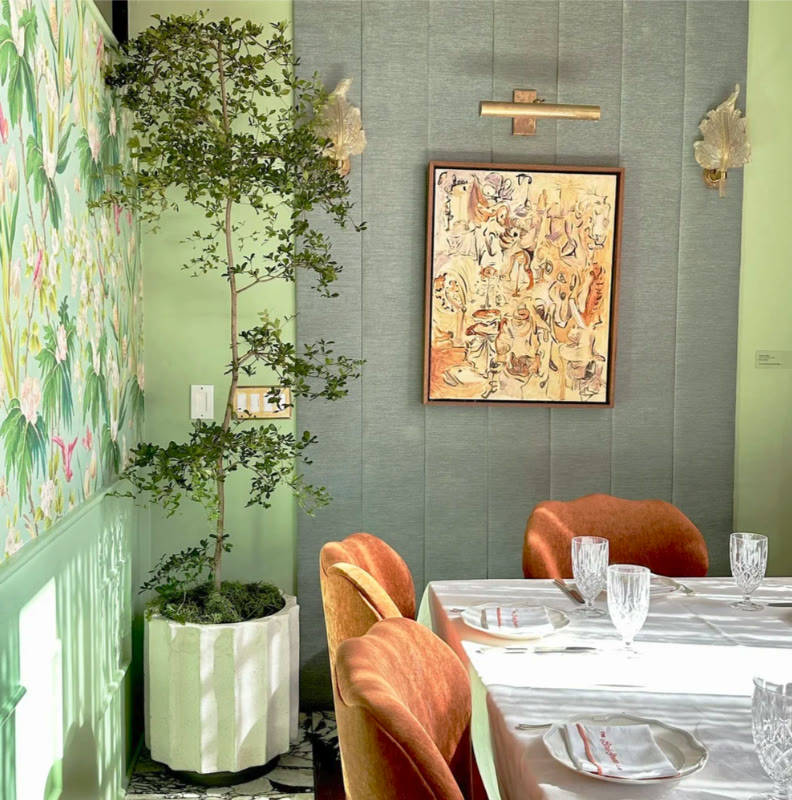
Walk into most plant-filled homes in Los Angeles and you will find a collection: forty pots gathered over forty impulses, each one loved at the register, arranged by the logic of available surfaces. The room hums with good intentions and reads like a greenhouse clearance. Walk into a space we would put our name on and you'll usually count a fraction of the plants — and feel twice the green. That gap has a name. It is the difference between collecting and curating.
A collection asks what else can I add? Curation asks what is this room trying to say — and what is the least it needs to say it? Every discipline that deals in beauty learned this centuries ago. Galleries do not hang every canvas they own. Editors cut the paragraph they love most. The restraint is not deprivation; it is how meaning gets made.
What the gallery knows
A museum hangs a painting on an empty wall not because walls are cheap but because attention is. Negative space is the frame the eye actually uses; crowd it and every piece loses. Plants obey the same law. A sculptural fiddle-leaf fig against two meters of blank plaster is an event — the branching reads, the leaves cast shadows, the plant gets to perform. The same tree wedged between a bookshelf, a bar cart, and five pothos becomes visual noise with a watering schedule.
When we edit a room, the first move is almost never adding. It is subtracting until the best specimens have silence around them. The plants that remain get instantly, visibly better — like turning the lights on in a gallery.
One great tree outperforms eleven small pots — in presence, in health, and in what it asks of you every week.
The one great tree principle
Here is the trade we offer clients constantly: the budget for a dozen small plants, spent instead on one mature, well-grown specimen — an olive with real trunk character, a strelitzia at architectural scale, a ficus with a decade of structure. The dozen small pots ask for twelve watering judgments a week and give back clutter. The single tree asks for one, and gives the room a protagonist. Scale is the most underused tool in interior planting; small plants in a tall room don't read as restraint, they read as an apology. Match the plant's scale to the architecture and the room snaps into focus.
A grammar of form
Curation needs a grammar, and ours is simple: every composition is built from structural, textural, and sculptural roles. Structural plants are the architecture — trees and large-canopy species that establish height and anchor sight lines. Textural plants are the prose — ferns, trailing vines, understory foliage that soften edges and connect moments. Sculptural plants are the punctuation — a cactus, an alocasia, a dramatic silhouette used the way a room uses one great lamp. Roughly: generous structure, supporting texture, and sculpture used sparingly enough to stay startling. Collections fail because everything is punctuation.
The edit
When we take on a home with an existing collection, nothing gets discarded carelessly — we sort. Keep: the healthy specimens with a role in the new grammar, often promoted into better pots and better light. Relocate: the right plants in the wrong rooms — the sun-starved succulent that belongs on the south sill, the crisped calathea begging for the north bathroom. Retire: the strugglers kept out of guilt, rehomed to friends or composted with honor. A plant that has spent two years dying slowly in a dark corner is not being loved; it is being detained.
Then the containers. Pots are pedestals, and a collection of great plants in a chaos of plastic nursery pots and novelty planters is a sculpture show on milk crates. We consolidate toward a family of materials — and suddenly twelve survivors look like an installation.
Curation is also a care strategy
The aesthetic argument usually wins the meeting, but the practical one wins the year. Forty plants acquired on impulse means forty different soil profiles, light appetites, and watering rhythms — a part-time job disguised as a hobby, and the reason so many collections quietly rotate through the compost bin. A curated composition collapses that complexity. When a room holds eight well-chosen specimens grouped by their needs, care stops being detective work: the bright-zone group drinks on one rhythm, the shade group on another, and each plant is in a placement where its default behavior is to thrive.
Health compounds from there. Fewer, larger plants in properly sized containers hold moisture more evenly than a windowsill of small pots that swing from soaked to bone-dry in a weekend. Air moves between specimens instead of around a thicket, which is half of pest prevention. And problems announce themselves early — on a protagonist you look at every day, the first yellowing leaf is news; in a crowd of forty, it is camouflage. The curated room is not just calmer to look at. It is measurably easier to keep alive, which is why our maintenance visits to edited spaces run shorter and find less to fix.
Rotate like an exhibition
The last habit curation borrows from galleries: the show changes. A blooming specimen earns the entry table, then returns to the greenhouse rhythm of brighter rooms; a seasonal composition marks the holidays and departs with them. Rotation keeps a home from calcifying and keeps plants matched to the light as it moves through the year. The room stays alive in both senses.
None of this requires loving plants less. It requires loving rooms as much. Collections happen to a space; curation happens for it. And the result, when it lands, has a quality photographs capture only half of — the sense that every leaf is exactly where the room always meant for it to be. Not more. Not less. Inevitable.
— Maia Flora, Los Angeles